Quick answer
Start with a visual inspection and moisture readings. Testing is useful when mold is suspected but not visible, when you need documentation or when you want clearance after cleanup. Small mold areas of about ten square feet or less can often be handled by a homeowner. Larger or hidden growth needs a professional.
Visual inspection comes first
The most reliable evidence of a mold problem is seeing it and finding the moisture behind it. A trained inspector looks at likely spots, uses a moisture meter and a thermal camera and traces any water stain to its source. There are no federal limits on how much mold is acceptable in a home, so numbers from a test should be interpreted by a qualified person.
When testing can help
- You smell mold but cannot find it
- There was a known water loss and you want to know whether hidden growth developed
- You need documentation for an insurer, a landlord, a buyer or a legal matter
- You want clearance testing after remediation to confirm the area is clean
When testing does not add much
- Mold is clearly visible. You already know you have it, and money is better spent on fixing it
- The test is a cheap kit that cannot be compared to outdoor air or interpreted reliably
Kinds of sampling
- Air samples. Collected for a short period and compared to a sample from outdoors on the same day.
- Surface samples. Swabs or tape lifts from a visible area to identify what is growing.
- Bulk samples. A piece of material sent to a laboratory.
Ask that samples are analyzed by an accredited laboratory, and that the person who collects them is independent from the company that will do the remediation, to avoid a conflict of interest.
How professional remediation works
- Locate and stop the moisture source.
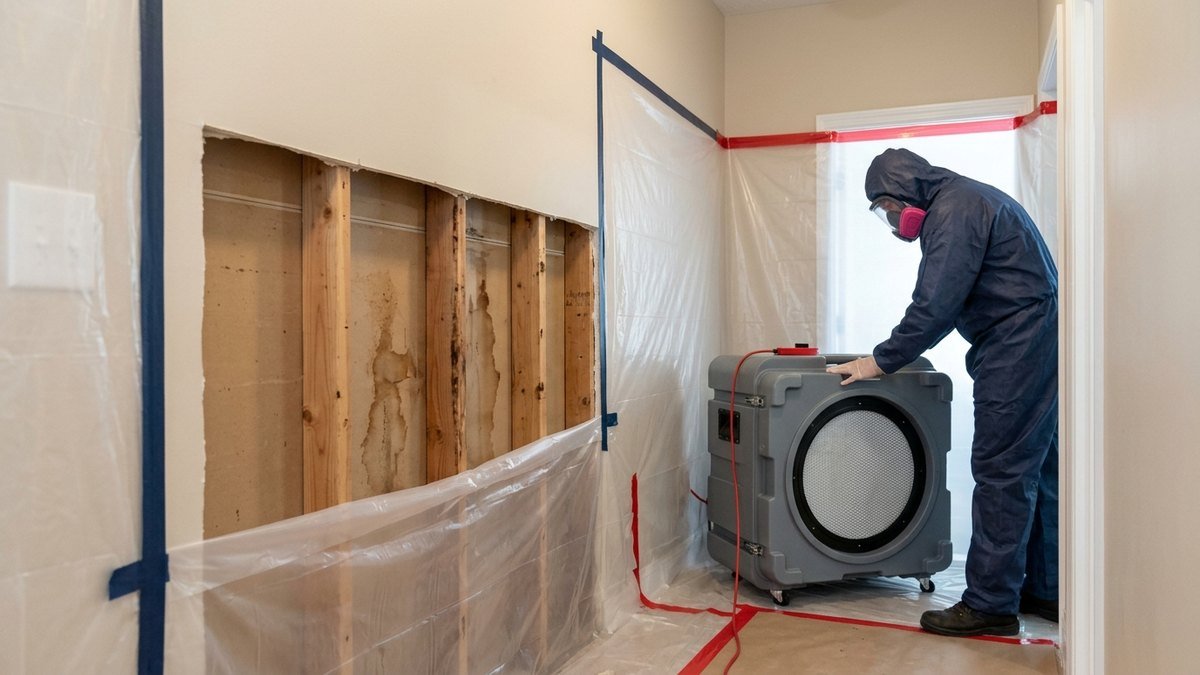
- Contain the work area with plastic sheeting and negative air pressure.
- Remove mold affected porous materials and bag them.
- Clean remaining surfaces with HEPA vacuums and damp wiping.
- Run HEPA air scrubbers.
- Dry the structure completely.
- Verify the area visually and with clearance testing if requested, then repair.
Do it yourself or hire someone?
| Situation | Suggested approach |
|---|---|
| A small patch, about ten square feet or less, on a hard surface after a minor leak that has been fixed | A homeowner can often clean it with proper protection. Wear an N95 respirator, gloves and eye protection. |
| Growth on drywall, insulation or carpet | These porous materials usually need to be removed. Professional help is advisable. |
| Growth inside walls, attic or HVAC | Hire a professional. |
| Mold after sewage or flood water | Hire a professional. |
| Anyone in the home has severe asthma or a weakened immune system | Hire a professional and consider leaving during the work. |
Frequently asked questions
How much does mold testing cost?
Prices vary with the number of samples and the lab. Ask for the number of samples, what is included and how results are explained before you hire.
Do I need to leave my home during remediation?
Often not for small jobs with good containment. For larger jobs or when someone is sensitive, ask the company and consider staying elsewhere.